




Alfa Laval
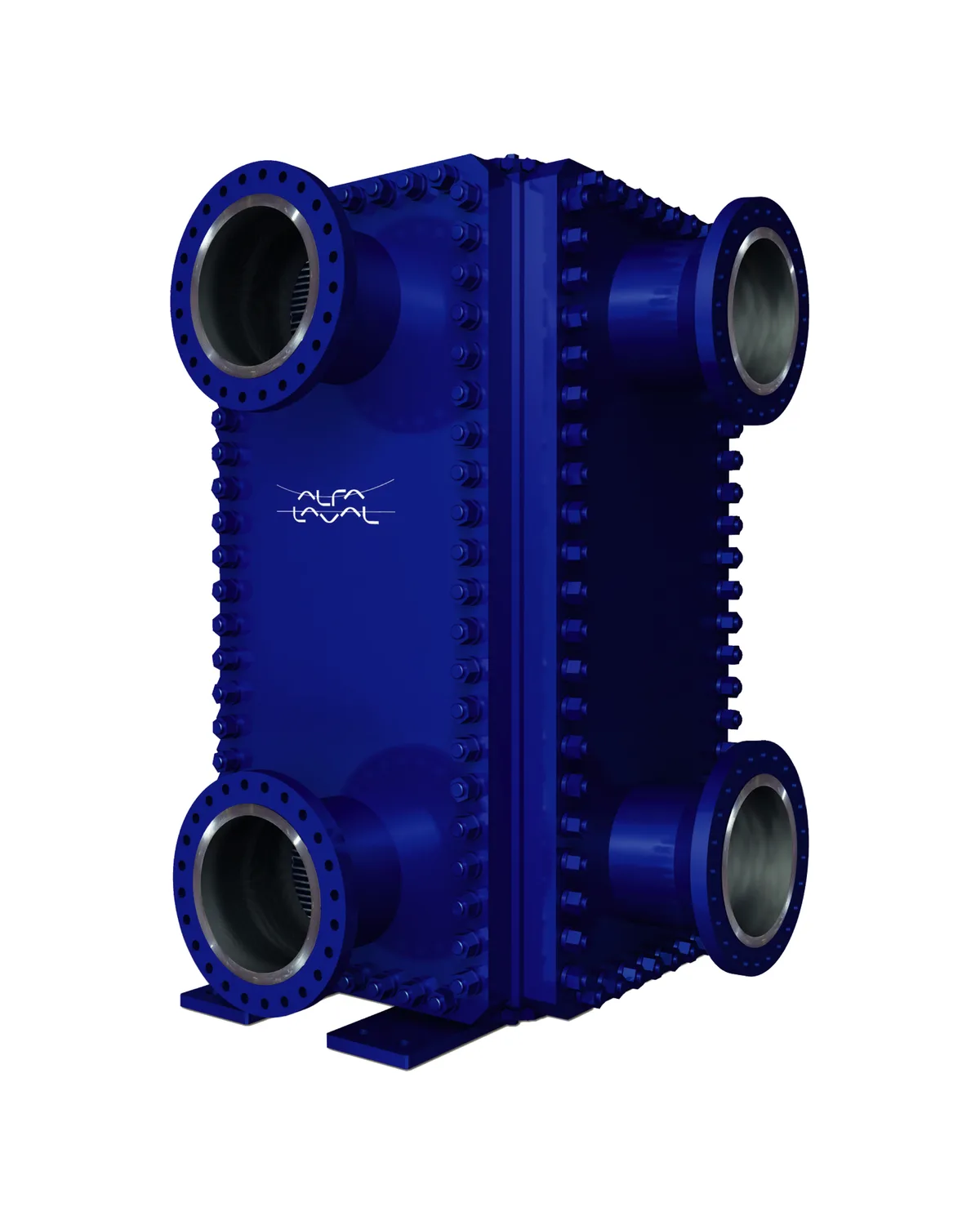
Compabloc Welded Plate Heat Exchanger
The Alfa Laval Compabloc is a fully welded plate-and-block heat exchanger with no interplate gaskets. It combines the thermal efficiency of a plate design with the robustness expected of a shell-and-tube, and every unit is custom-built for its duty. It is the go-to choice for aggressive media and demanding high-temperature, high-pressure process positions.
Product Benefits
- No gaskets to fail: Because the plate pack is fully welded, there are no gaskets between plates to age, swell or leak, a decisive advantage with aggressive chemicals and hot, high-pressure services.
- Very close temperature differences: The corrugated-plate core reaches very close temperature differences, so duties that would need an oversized tubular bundle fit into a much smaller footprint.
- Still mechanically cleanable: Unlike many welded designs, the Compabloc stays cleanable: the panels bolt off to expose the plate pack for inspection and cleaning.
- Proven installed base: Tens of thousands of units worldwide speak to how widely the concept has been proven.
- Code compliant: It is built to the ASME and PED pressure vessel codes.
Where It's Used
- Full range of process duties: Its duty list covers most of process heat transfer: heat recovery, heating and cooling, condensation and partial condensation, reboiling, evaporation and gas cooling.
- Distillation column service: Reboiler and condenser positions on distillation columns are classic Compabloc territory.
- Chemical and refining plants: It is most at home in chemical, petrochemical and refinery plants, where aggressive media, elevated temperatures and high pressures rule out gasketed designs.
- Saves plot space: Its compactness also saves structural steel and plot space in those installations.
Good to Know
- Corrosion-resistant plates: Heat transfer plates are offered in a range of corrosion-resistant materials, from 316L stainless through high-alloy grades such as 254 SMO, 904L, Alloy C276 and Alloy C22, to titanium.
- Lined pressure panels: The pressure-retaining panels are carbon steel lined with the plate material, which keeps the wetted surfaces noble without pricing the whole unit in exotic alloy.
- Engineered per duty: The range spans a wide series of frame sizes and each exchanger is configured for its specific duty, so early engagement with duty data pays off.
- A recovery investment: Its ability to run close temperature approaches also makes it a strong heat-recovery investment, not just a problem-solver for aggressive fluids.